January 31, 2026
Dear Sophia,
You are apparently in your gassy stage, and your struggles are every bit as epic as those of the great gas giants among the stars. Much of the night you grumbled and struggled, contracted your Buddha-like belly tightly and pedaled your legs fiercely and it all seemed futile.
The gas would not move through you.
You did not know how to exfiltrate the fart.
I moved in. Started to warm up. Swung my arms across each other like a wrestler approaching the mat. Cracked my knuckles, and also my neck, like in the fighter movies, where one of the badasses shows he’s that much badder because he can crack his own neck, without use of his hands.
I worked through five different ways of moving you. Side to side swing. Burping over the shoulder (no luck). Head down between my thighs as I sat in the rocker, as when you were head down in the womb.
Then I bicycled your legs and got several farts out of you, each a cause for celebration. (Your mom had thought this maneuver didn’t work with you). Then head on my chest in the rocker. Face down in the rocker. Curled up on your side against my chest in the rocker.
It was a lot like something you’d see at the World Wrestling Federation.
You were intermittently calm. Then you’d get uncomfortable again. The bicycle yielded no more fruit. I took you to mom and she fed you and you finally fell asleep. But your mom is exhausted. She hears your grumbling struggles all night and is awake with you. I apparently sleep through some of them.
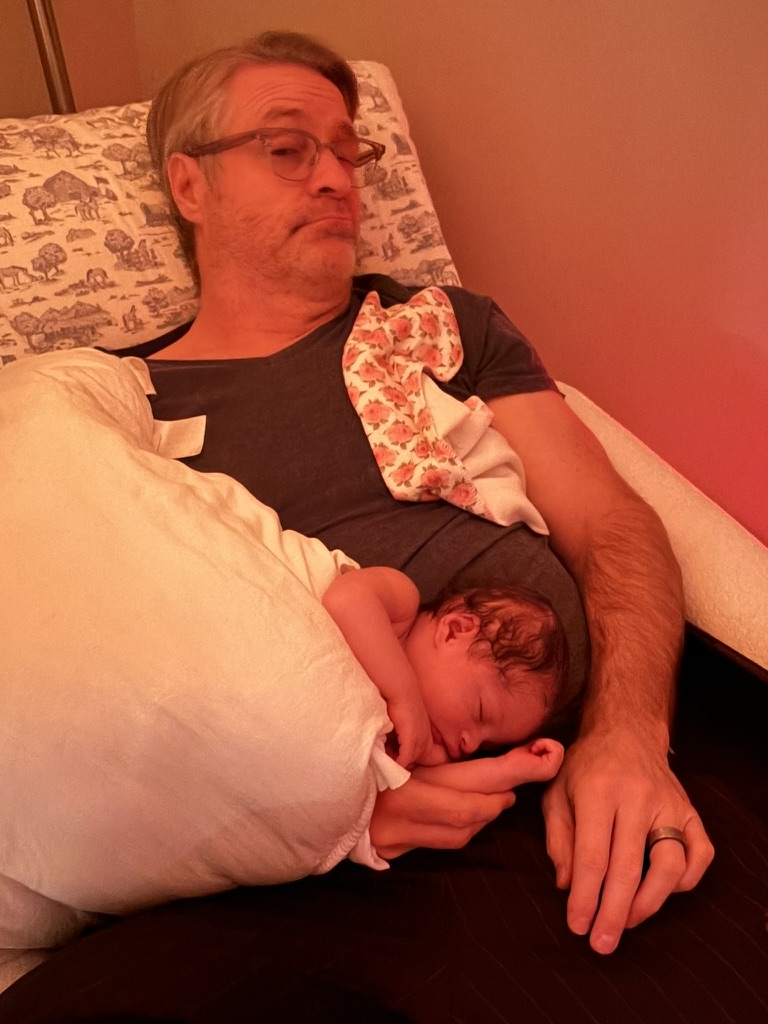
Why does no one talk about this? Babies farting. I’ve never heard anything about it. We’ve all heard the phrase sleep like a baby, but where is our farts like a baby? To fart like a baby is to fart not very effectively or with assistance, and surely there are many places the world needs that metaphor. Example: he does homework like a baby farts — with lots of outside help. * * * Your cousin (once removed) Fiona responded belatedly today to my Facebook post of over two weeks ago, in which I’d solicited thoughts about the name Ingelein. “Also wir finden Ingelein nicht so passend und gefällt uns weniger, aber Deine Mutter hieß doch mit 2.Namen auch Amanda, was meint ihr dazu?? Sophia Amanda Powell??” That is, she and my Aunt Christa — who have always voted as a bloc — don’t find Ingelein so suitable. Their opinions were among those that meant the most, but I simply let Fiona know that my mom hadn’t identified with Amanda and we had decided on Ingelein and liked it. * * * You slept on my belly the entire time we watched “My Old Ass,” a movie featuring Aubrey Plaza and some young actors I had not seen before. The premise is that an 18-year-old bound for college, Elliott (played by Maisy Stella), takes some psychedelic mushrooms and meets her 39-year-old self (Plaza), who refuses to tell her what stock to buy but warns her not to get involved with a boy named Chad.
Of course Elliott meets Chad the very next day, as both are skinny-dipping at a watering hole, and when she learns his name she bolts. And of course Elliott keeps seeing Chad again — he has come to work for her father on the cranberry farm for the summer — and she begins to be drawn to him. Elliott also has phone calls with her future self, even though she’s no longer on mushrooms, which is one of the silly inconsistencies about the movie. Elliott’s older self (played by Plaza) put her number in Elliott’s phone during the mushroom trip, and now they can talk on the phone. Just as the screenwriters contrived not to have younger Elliott ask older Elliott why she should avoid Chad, which is the world’s most obvious question, they also don’t have younger Elliott ask, “What year is it where you are? Where are you? I wonder if we can meet again without the mushrooms?”
Older Elliott disappears on a retreat and is unreachable for several days, and that’s enough time for younger Elliott to fall for Chad. When future Elliott appears at the farm (again without any mushrooms, and now the mechanism of her appearance is hopelessly muddled) and finds out, she leads younger Elliott away from the house and into the trees, where she implores her younger self not to continue.
And younger Elliott finally asks why not. “What did he do that was so wrong?” she demands. “Just tell me.”
Future Elliott at first refuses to say.
Then the movie becomes unexpectedly touching.
“Because he died,” she says. (I’m paraphrasing). “Okay? He didn’t do anything wrong. He died. And no, there’s nothing you can do about it, though you’ll try.”
Younger Elliott is floored, of course. We see her future self struggling to maintain her composure. We start to feel her sadness about her lost love. And we understand why she doesn’t want her younger self to experience the pain she has endured, which, we now realize, must be what has so thrown her life off track that she is unmarried, childless, and back in school (getting a Ph.D. in something) on the cusp of 40 — all unwelcome surprises for younger Elliott, who has big dreams.
Younger Elliott feels the blow. We can see her trying to absorb it. But then she says that she is going to fall in love with Chad. She is going to follow that love where it leads. Maybe her younger self is young and dumb, as her future self says, but taking the chance that isn’t smart is the only way to live, and she wants to live, etc.
What really affected me was when Chad showed up. (To confound even further just how future Elliott exists at all, he is able to see future Elliott).
There are awkward introductions, and younger Elliott lies about who future Elliott is. Future Elliot sees what there is to see between her younger self and Chad, looking at each other as they do, and says it’s nice to meet him before insisting on bowing out to leave them alone. Younger Elliott tries to persuade her to stop, but future Elliott says she will leave them be. My interpretation was that she was letting them do and be as they wished, nevermind the pain to come.
But as she goes to leave, Chad moves to give her a hug. She hesitates, then accepts the embrace, and once she’s in it, hugging the love of her life when he was still alive, just the kind of heartbreak we sometimes have in dreams about those we’ve lost who are suddenly there again, you don’t find it believable that she hasn’t been sobbing since he first came out of the trees to find them. Imagine, holding a long-lost love of your life in your arms.
Of course Leah and I both have tears in our eyes, nevermind the manipulative and leaky sci-fi premise.
It’s really the same choice we made, I realized.
Like younger Elliott with Chad, your mother knows she may not have much time with me, and I know I won’t have that much time with her, or with my daughter. And this is the central sadness at the heart of my hesitation in making the decision to marry your mother and have a child.
But, as I learned when my mother was dying, and learned further after she was gone, the sadness doesn’t exist without love as its fuel. It’s the love that animates the sadness.
C.S. Lewis had something to say about that. The Oxford don and author of The Chronicles of Narnia and writings on Christian apologetics was in his 50s, a lifelong bachelor, when he made the decision to marry a significantly younger woman, an American academic named Joy Davidson. The year was 1956.
Like your mother and mine, Joy was brilliant, intrusive, demanding, alive. She disrupted Lewis’ routines, challenged his thinking, and—worst of all—made happiness imaginable. So they had a civil marriage, but it was a decision they made partly to help her with her U.K. visa and give her, a single mother of two, some stability. It was legalistic, not romantic.
But when Davidson was diagnosed with advanced bone cancer, in 1957, Lewis understood the full cost of his decision. The debt had come to be repaid. And here is what I admire about C.S. Lewis.
Facing the likelihood of losing her, he asked for a second marriage—this time a Christian ceremony in a hospital room. The risk was no longer theoretical. He chose it anyway.
Sometime around this time, he wrote:
There is no safe investment. To love at all is to be vulnerable. Love anything, and your heart will certainly be wrung and possibly be broken. If you want to make sure of keeping it intact, you must give your heart to no one, not even to an animal. Wrap it carefully round with hobbies and little luxuries; avoid all entanglements; lock it up safe in the casket or coffin of your selfishness. But in that casket – safe, dark, motionless, airless – it will change. It will not be broken; it will become unbreakable, impenetrable, irredeemable. The alternative to tragedy, or at least to the risk of tragedy, is damnation. The only place outside Heaven where you can be perfectly safe from all the dangers and perturbations of love is Hell.
Not to risk loss in order to love, he is saying, is a kind of hell on earth.
Joy recovered, and they were given a brief reprieve—three years of intense, domestic happiness. Lewis later said those years compressed a lifetime of marriage into a season. When the cancer returned, it did not come as a surprise. It came as that debt calling him again.
Joy died in 1960. Lewis was devastated. His book, A Grief Observed, is a record of a man who loved knowing the odds and paid them in full. He did not regret the risk. He learned that love does not protect you from suffering; it sharpens it. And that choosing reasons to suffer, somehow, is the point.
Love,
Dad
