Episode 7: A Dream I Never Knew I Had
January 2026
Dear Sophia,
You’re just days away from your birth and I still have to finish my broad sketch of how I met your mother, and how our unlikely relationship was itself born. In the last letter, Episode 6: A Breakup Email, I shared a break-up email I never sent.
If most age-gap relationships fail in large part because of social pressures, it may well be that the people around a couple with a large age gap took their measure, felt something was off, and acted on that belief. I’ve read tales online from older men in such couples who reveal that their sons, daughters, or friends became estranged on account of their relationship with a much (much) younger woman. Some of the much (much) younger women tell stories of their parents cutting them off.
And I get it. Presented with the reality of a much older stranger and, well, you, I’d have heartburn. What’s really going on here? I’d want to ask him. Help me understand. On average, over time, the crowd does have its wisdom, and opinions worth pausing for.
But for a long time I overlooked a subtle blessing that had been visited upon us: the members of the crowd your mother and I knew well, and even people who had recently met us, weren’t nearly as bothered by it all as I was. Our closest friends, our family, even new acquaintances took our relationship in stride. We weren’t strangers, who triggered assumptions, but people they could know and observe.
My best friends concluded our relationship was good for me, and they loved Leah. I’d known your mother for two months when Tedd, a dedicated dad with a daughter only eight years younger than Leah, sent me a text consisting of a graphic of a diamond, and below it a hand whose index finger pointed upward, at the diamond.
“Oh, I totally get this,” my friend Jeanne said to us at a dinner she hosted for us in her home in DC’s Cleveland Park, ticking her finger back and forth to indicate Leah and me. Jeanne is my age, Tedd is two years older, and both have known me for 30 years, since my time in DC in the 1990s.
But the biggest blessing came so easily it almost escaped my notice and appreciation: the acceptance of your mom’s side of the family. When I first met your mom’s mother, at that wedding on Lookout Mountain, I was surprised at how friendly and welcoming she was. “We’ll have to have you over for dinner sometime,” she said, within moments of meeting me. I also had a long phone conversation with your mom’s father – your Pop-Pop. He didn’t ask all the questions I would have asked — he didn’t have to, because I embedded the answers in what I was saying to him. He also read Ordinary Magic on the sly. He never questioned me or his daughter about what we were thinking.
In fact, I never caught a sideways glance from any of her close family or anointed family, the chosen “aunties” and godmothers, not one silly joke, nor your mother telling me that so-and-so had talked to her and had some concerns. I was startled by the easy acceptance of your mom’s younger sister, Erin, your mother’s beloved Auntie Prudence, and Uncle Ricky, a gravel-voiced North Carolinian who simply promised me a baseball bat if I messed up.
After meeting me, a friend of the family closer to my age texted your mother, Please send me the address of the place where you met your husband.
There were so many wise, perceptive people who not only didn’t look at us and see something wrong but thought we were a great couple, and could see that we worked. It took me a long time to realize what was really missing from our relationship: the discomfort or disapproval of anyone who knew us.
***
Your mother had experienced far less loss in her life than I had, and was at the age where most people don’t think it’s possible to get old, let alone die. But your mom isn’t like most people. She was thinking about the long term at least as deeply as I was. She was thinking about legacy, and what I sometimes call the endgame: how much less time she’d have with me, and who would leave whom through the door of death.
You see, in the average relationship, the man is a year or two older than the woman, and we know women live about five years longer than men. That means the average woman in a relationship will outlive her male partner by only about seven years. And there’s always a decent chance she won’t have to live without him for very long or not at all.
But your mother? I think she had to know that there was a much stronger probability that I would leave her, and for a very long time. She didn’t have the comfort of thinking, Well, maybe I won’t feel his loss for that long before I die, or It’s quite possible I’ll even die before him. She had to know she was stuck: she would very likely live without me for decades.
In her shoes, I just don’t think I could have done it.
That’s why I will always remember a conversation we had in the fall of 2023. We were still in the DC apartment in Mount Vernon Triangle. I remember she was standing at the kitchen sink. She was trying to explain to me, not for the first time, why she wanted me to plan a weekly date night that was just for us, and not also the social group I had begun during the pandemic, or a Harvard Club event, no matter how fun. But this time, she explained herself differently.
“I don’t know how long we have while you’re healthy,” she said. “There may come a time when you can’t do anything any more,” she said, “and I need to take care of you.” She looked at me. “And I’m here for that.”
Daughter, I was speechless. What had she just said?
Words, a conviction, a commitment I would never forget. Most younger people – and I was probably one of them once – would want to run away from someone they would very likely need to take care of decades sooner than other potential mates. I saw this as a kind of loss. A sacrifice. But your mother was here for that.
I’d never met anyone who offered me so much love, let alone courage. Whether the critics of our relationship were mostly imaginary projections of my own myriad fears or actual people, this conversation marked the time when I began to ask myself, Will they be there, at the end?
Your mother, who remembers everything and treasures every moment and every card, flower, and gesture, knew what she wanted to be able to hold on to.
“I want to build up some happy memories to hold on to,” she went on, “during that hard time and after you’re gone.”
She wanted a legacy of time and attention, a reservoir to draw from.

You see, where I felt fear, she felt possibility. I worried about what would happen. I worried about being a burden. She wanted the risk of that to be her choice. She thought it was figureoutable.
Maybe it was. Her attitude and her patience inspired me. If many of my fears were on her behalf, and she didn’t share them, did it make sense to hold on to them? What if we really could just figure it out? What if we didn’t have to know the answer before we began? What if we just had to take the risk of failing, being hurt, feeling foolish, feeling judged, judging ourselves, but especially the risk of loving, investing, and inevitably losing, because to love something is also to sign up to feel loss. All love means choosing something to lose, and we can never know how soon.
So yes, I wanted to choose possibility over fear. I wanted meaning and I feared a life empty of it. I was well aware that people who work in hospice report that what the dying regret most toward the ends of their lives is that they didn’t let themselves feel and they didn’t take chances. I didn’t want to feel that kind of regret.
When I met your mother, I think I still believed that any promise of real happiness had to have something wrong with it. At bottom I just couldn’t believe my good fortune when I met her, a flaw in my character or wiring that showed up in concern about age gaps and other people’s taboos, a flaw that filled me with doubt and trepidation. The relationship with your mother has become a lesson I needed in learning to let myself feel hope and gratitude.
So you need to know that your mother and I, getting together – it doesn’t make any sense. Certainly not at first, to some people, and to many strangers, the people you’ll need to deal with most of the time, it will never make sense. But it doesn’t have to make a rational kind of sense even to us, let alone to anyone else. That’s what I finally figured out. The heart has its own reasons. Love can be its own justification. Love can conquer fear and immunize us against judgment. It took me decades to figure that out. Your mother already had.
Could this be the place to cast my lot? To settle down in a sense that’s not akin to death, as I might have imagined it, but in the sense of committing, expanding, growing? The sense in which, as it happens, she already lives by.
Can I let myself be happy, at last?
* * *
It would take me another year to take your mother back to Switzerland and drop to a knee on a patch of grass high above a mountainside village called Wengen, in the shadow of Jungfrau, Eiger, and Mönch. And soon enough I’ll write you and tell you all about how we got there.
It took me a long time to decide your mother and I don’t have to explain ourselves to anyone else, but, yes, I do want to explain myself to you. I want you to be able to know me, if that’s what you want, and to have answers to the many questions you won’t think to ask while I’m around to answer them. I cannot believe there are so many questions I never thought to ask my mom. I thought I knew all I needed to know. I was wrong.
“Different stages of life bring their own sets of questions.” In the years after his father’s death, the man who wrote that, the writer Jelani Cobb, realized he continued to understand his father “through a series of epiphanies, the way the subtler points in a film can occur to you long after you first see it.”
Some of the most momentous questions I could have asked my mother arose only after she’d gone — one in particular came about five years to the day after her death, in fact. But we’ll get to that. Most people who know me will hear about those questions, and some of their answers, in these letters . . .
I started writing this story for you in earnest when I realized, with a start, that you were on your way into the world, and you’d be here soon, and in the blink of an eye you would be a young woman. The days are long but the years are short, I am told, about raising children. And for you and me, the years are shorter yet.
Now, I didn’t know a you when I started this. Having just appeared in the womb, you were still an abstraction, a bit more than an idea, a fair amount weightier than a possibility. Not even knowing if you were a boy or a girl, I could form no mental image of you.
Then your mother and I learned you were a girl, and you began to take shape in our imaginations. My brain seemed unable to imagine a child with my looks in her, so I imagined an infant, a six-year-old, sometimes a 16-year-old, who looked a lot like your mother.
When I imagined what you might want from me, I thought also of your mother, and her love for her parents, who were older than the average when they brought her into this world. I tried to empathize with how you would probably want to understand and know your father. I think most kids do, especially after their parents are gone, or going.
But most kids are born, on average, with more time to spend with their father than you will have. So I feel some urgency to give you, and your mother, some part of me that will persist beyond my mortal form, though I confess I harbor hopes still to be alive when these letters come to mean something to you.
I imagine you will come to these letters a different person each time, and each time you will find new layers of meaning. Maybe when you’re sixteen and you’re curious about dating, you’ll ask your mother how we met, and she’ll show you this chapter. Maybe when you’re twenty-five you’ll wonder how I thought about work and careers, and you’ll dog-ear a new page. If you’re twenty-nine and you break up with your boyfriend of three years and you feel like your life is over, maybe you’ll come here to see if there’s something about loss that didn’t seem so relevant the other times you read it.
And maybe then, and again when you’re nearing forty, then fifty-two, when I’ve been gone for so many years that I’m a distant memory, you’ll find in this story a way to come to terms with loss, failure, or fear and embrace life, risk, love, and possibility. I want your knowing how much your father loved you, and cared about how you’d feel, to be a deep reservoir for you.
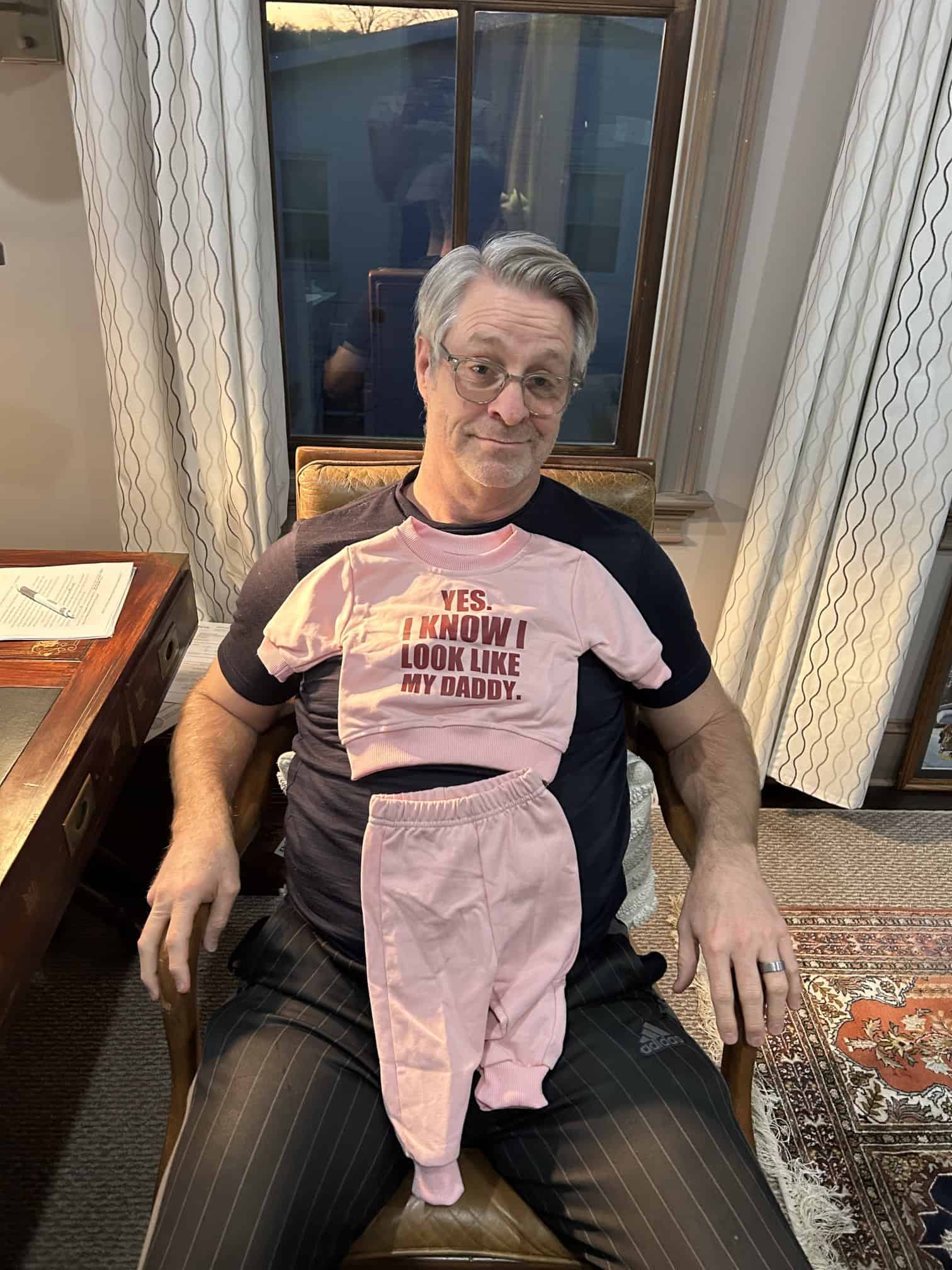
And so here I write, with you just a few days away. The feelings are unfamiliar, large without being overwhelming. There is no waiting like the waiting of the first-time father, simultaneously knowing his life and heart and mind will change forever, and having no idea how, but I feel at peace. I am starting to wonder if I am in the midst of a great turning. From fear and doubt to gratitude. From the anticipation of failure to the prospect of an unending love.
As I stand at the threshold of a dream I never knew I had.
I can’t wait to meet you.
I’m recounting this story of love and other demons on this blog and on my Letters to a Little Girl Substack. Subscribe to one or both and spread the news of this developing story. And if it moves you, share it!
