Episode 4: A Look on Lookout Mountain
January 2026
My dear daughter,
Dinner after the wedding was outside, on a patio, under a white tent. As evening descended the lights of Chattanooga were sprinkled across the valley below. The bride, Erica, and the groom, Cole, walked around and said hello. Later, your mother would say that she saw how they looked at each other, saw their obvious love and admiration, and thought, I won’t settle for anything less.
After dinner, everybody danced. Your mother, as you will have discovered, is a lovely dancer. When she first danced in my apartment, she was so smooth, her movements so complex yet precise, that I assumed they were choreographed. She had learned them while a competitive cheerleader for eight years, I figured, and liked to break them out now and then, or she had practiced her routines in front of a mirror at home. This amused her: in fact, she was improvising her moves on the spot. On the patio I took a video of her dancing with her sister, Erin, and her mother, Froncé, to Abba’s “Dancing Queen”. You can hear my delighted laugh in the background.
We took a break, sitting down on a low stone retaining wall. The evening had grown cool. I took off my blazer and draped it around her shoulders. I looked at her without saying anything. She looked back, quietly, eyes alight. In the months since we’d met, I sometimes just slowed down and tried something completely different: I gazed into her eyes, seeing into the depths of them. And she looked right back, unblinking. She didn’t look away, ever, didn’t make a joke or other diversion. Open, vulnerable, and accepting, she just saw me, and she was smiling. I swam in those depths. She would later tell me that to her I felt grounded and safe, open and transparent in a way that allowed her to exhale.
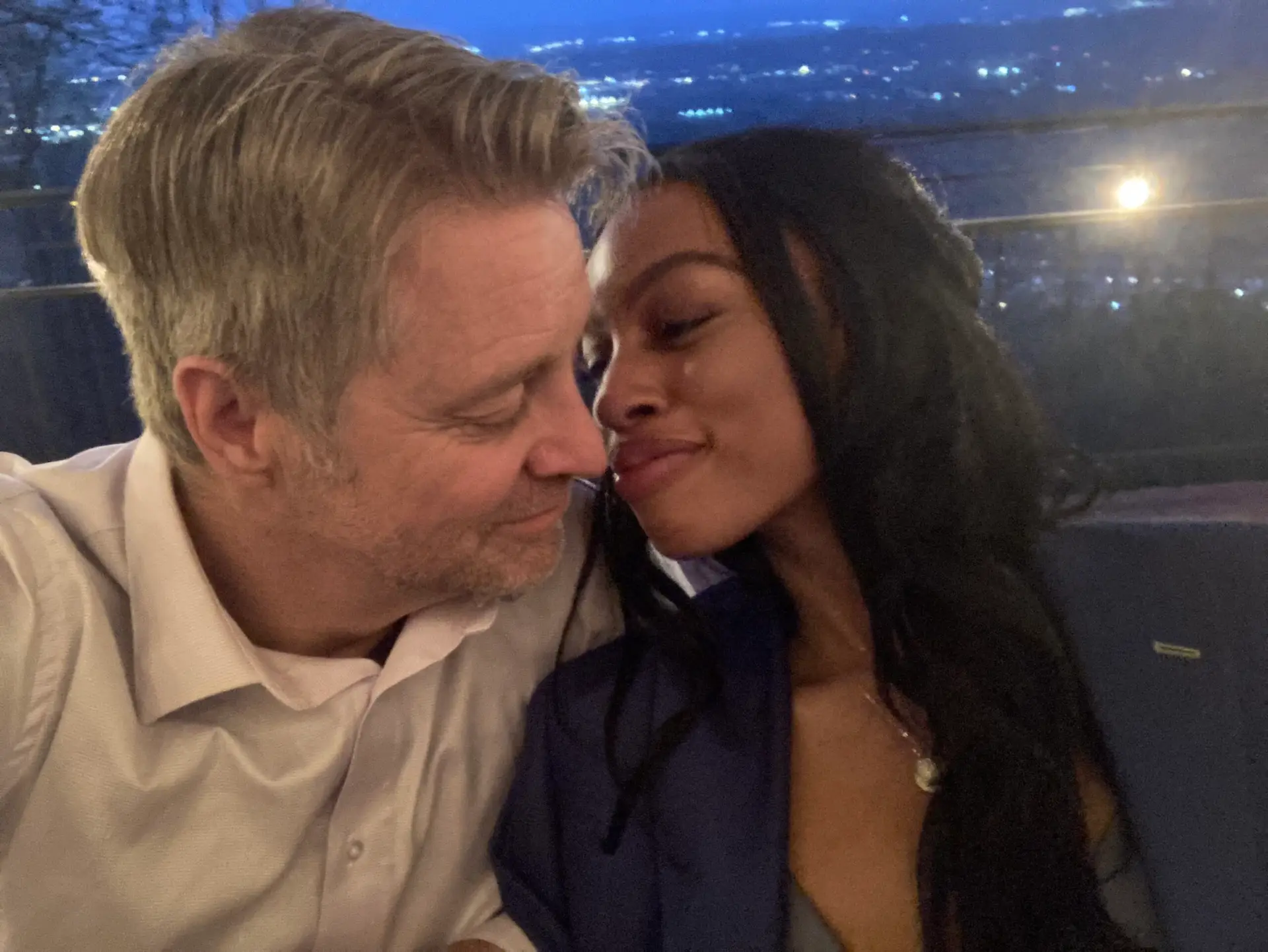
A wedding photographer came round to take our picture, and then we decided to take some of our own. We turned toward each other, and someone – I, or another guest – took the picture that’s still on my phone, and is blown up and sitting on a music stand on the landing at the top of the stairs in our house in Alexandria. In that picture, with the lights of the distant city dotting the bluish palette behind us, your mother, serene, a light smile adorning her features, looks at me, smiling, with her eyes nearly closed, in a way we all want to be looked at some day. When Leah saw another picture taken at the same time, she thought I had been looking at her much as the groom had the bride.

We returned to the dance floor. “Where did you come from?” I said. “How did you get here?” You could have said I was joking, and you’d be right, but I was also truly in a state of disbelief. Who was this person? How had she come into my life? What was I supposed to do now? And this feeling of disbelief came out every so often as “Who are you?” and “Where did you come from?”
“Well, I’m here now,” she said, eyes flashing. “The question is, what are you going to do about it?”
“Is that the question?” I said, smiling.
“Yes, it is.” She shrugged sweetly.
This was both thrilling and scary. She was ready for me to do something?
We walked over to the retaining wall where we’d sat for our pictures. I confessed some fears. That she can’t know what she wants, for example. Surely she hadn’t had enough relationships, enough mistakes under her belt. My own disbelief made me doubt her too, and I discounted her ability to know. My bias for experience over intuition was so fundamental, I didn’t even notice it.
I did not add that I didn’t feel as confident about the future as she did. The previous decade had been a rough one, kicked off by my divorce and mother’s death, punctuated by the heartbreak of my medical startup company’s demise and capped off by the crushing lack of optimism that had been my pandemic. A terrible period I was glad was over, but that I wasn’t emotionally, spiritually, really out of. It had left its mark on me. From the time I had accompanied my mother to the border of life and death, in 2014, I had been thinking about the endgame, and the languishing and loneliness of the pandemic had instilled in me a fear of a failed life and meaningless death. Not long after the world reopened, I wrote in my journal, You are headed to the grave, man. There is no escape. There’s only graceful exit.
Illness, further injury, financial challenges, romantic pains, losing my last remaining aunts and then friends starting to drop away — these are coming, and it makes no sense to be attached to what life is like now.
I did tell Leah, “I’m discouraged by the various mechanical problems of the body I’ve run into.” I’d been fit all my life. I had lifted weights regularly for thirty years (though I got bored of them, in my mid-40s, just when a man most needs to preserve muscle mass). I’d been a sprinter and a wrestler and a running back, quick and limber, a tireless hiker and an adept yogi even just a few years before.
She knew I now wrestled every day with the feeling of aging and decline I got from my painful lower back and right hip. It all seems to have started falling apart in the pandemic. So many things were going wrong then, and my body was no longer bouncing back from stress. Did the pandemic’s effect on my mind, my immune system, and my overall health express itself in the lower-back pain I had developed? Perhaps. Moving my body hurt. Getting out of chairs hurt. Bending over to put on or take off pants hurt. Bending down to slide on or off shoes hurt. I couldn’t imagine how I would have a child. My body wasn’t functioning.
There is nothing that can make a person feel old like a bad back. Grunting, groaning, stooped over for the first ten steps out of a chair, as much a marker of age as the act of peering over bifocals. For some time after I met your mother, I often imagined I was worried about what others would think, but at bottom I think I was projecting onto them my own fear of aging, of decline and other imperfection, and my own judgment of those things. I was suffering from my own ageism. If I were her, I would have run away.
And I told Leah the idea of kids was utterly terrifying. And not just because my body wasn’t cooperating. “I can’t speak for you,” I said, “but I have daddy issues.”
On our first date, I had given her a copy of Ordinary Magic, the memoir, biography and travelogue I’d written about my mother’s final years. And she’d read it soon afterward, even made notes, so I knew one of the things she’d read was how my mother had told me, when I was seven, that the man I called Daddy was not my daddy and my real daddy had left before I was born. And that boy surveyed the landscape of his loss and, in my mother’s word, wailed, with an incisiveness that still startles me, “Now I’ve had two daddies and now I don’t have any.” When my lost Daddy began the first of his three lawsuits to take my sister away, on grounds my mother was unfit, I had to choose. By the time my mother, nearly bankrupt, had to let my sister go, I had shut him — and perhaps fathers and fatherhood generally — out of my life. My “real” father, meanwhile, shut me out of his: we moved to Colorado when I was nine and lived 19 miles away from him, but we may as well have lived in a parallel universe. The former Green Beret avoided me like I had explosives strapped to my chest. You could say the last time I had felt safe to let myself imagine the embrace of a family, I was sleeping with a teddy bear.
Leah looked into my eyes and said, “I’m here to talk about these things. I’m here to listen. But I believe you can do anything.” She nodded. “You are the one that I want.”
* * *
In the weeks after our first date, we had often been in touch by text and video call. In mid-January of 2023, your mother took the train down to Washington, D.C. and stayed at a hotel near my apartment. Hiding from the cold in DC’s restaurants and museums, we had the first of many delightful times. A few weeks later, we met for a weekend in Philadelphia. Next, we flew to Houston for a Mardi Gras Ball organized by a Houston Rotary Club I had joined, dressed up in black tie and gown, and danced to a fabulous nine-piece band. When we closed the distance between our cities and got together, we got along famously.
“You don’t ever annoy me,” she told me once, sounding amazed. “I love my family and my friends. My sister is my best friend. But if I hang out with them for more than a few hours I want to kill them.”
She was always game. Never too tired or bored to respond with anything less than enthusiasm to my texts, my ideas, my jokes, my singing. Did she know how to create and share a Google Drive folder so we could work on her idea for her coaching business?
I don’t! She texted in response. I’m sure it’s figureoutable!
What if I send a morning text saying, simply:
Boop-de-doop! 🤗?
Well, she consults the feeling in her body, and then she texts:
Boop-de-doop feels so good to me ! ☺️
This nickname and its many rhymes and variations I still use today, complete with expertly crafted songs like You put the boop / in the / Boop-de-doop. You may well become known as the equally artisanal Bippity-bopp.
We teased each other gently, finding the humor in our differences.
“What is this on my shirt?” I ask, in mock outrage.
“I’m Black!” she cries, the brown dust my shirt is wearing being her makeup.
“You’re grounded!”
“Reparations now!”
She was constantly expressing to me what sounded like love: her concern for me, her support of me, her admiration for me, how happy it made her heart to see me happy, her eagerness to be touched by me, and held. She said sometimes she wondered, “Are you really here, right in front of me?” She said she felt surprise that I was there, that I existed, that we had gotten together. In early March, a few weeks before the wedding on Lookout Mountain, we had been sipping milkshakes at a Shake Shack in DC’s Penn Quarter, like teenagers. We had decided, also like teenagers but in the 1950s, to go steady. To see no one else.
In the hotel room after Erica’s wedding, she said, “Tell me something I don’t know.”
I had something on my mind. But I stalled. “What do you mean?” I said. I wondered if she knew. (She did).
Eventually I said it. “Well, I find,” I said, adding words to take up time, to be less unnervingly direct, “that the word love is sometimes coming to mind.” Yeah. Not I love you but The word has entered the conversation of my mind. As she remembered it later, I had said, “I keep wanting to say I love you.”
Her eyes gleamed. “Really?” she said, brightening. She nodded. “Me too.”
She later told me she worried maybe she had said too much, even if it was true. But I still didn’t tell her directly that I loved her, even after she told me she had known early on that she wanted to be with me. It felt irresponsible to say more, when I couldn’t be sure of what I would do, whether I could commit. And always with me was that low-level terror of leaping into an abyss. As many thousands of feet deep as the years between us, it seemed truly without bottom, and I felt vertigo when I looked upon it. She had once distinguished between the feeling of love and the decision of love, but it pained her.
